Five sections — work through them in order, or jump to what's most relevant. Each section takes around 10–20 minutes.
Your overall progress0 of 5 sections complete
1
Introduction
2
Foundations
3
Core Principles
4
Activities & Planning
5
Embedding ESD
Section 1
Introduction to ESD
Before you begin
This short self-assessment helps you reflect on your current ESD practice. Use it before you begin the Learning Journey.
For each question, give yourself a score from 1–10, with 1 being the least and 10 being the most. Your scores will not be shared — they are used only to measure the impact of the ESD toolkit by comparing your answers before and after completing the Learning Journey.
Takes around 5 minutes to complete
No right or wrong answers — just honest reflection
Retake it at the end of the Learning Journey to track your growth
Education for Sustainable Development (ESD) is about equipping learners with the knowledge, skills, values and agency to navigate and contribute to a rapidly changing world. This isn't something extra, or more work — excellent teaching does this already. Through ESD, we can enable our learners to contribute positively to sustainability solutions in their lives and work.
Why does it matter in FE?
→
Our learners are the generation who will live and work through the climate transition, the green economy, and a radically changing jobs market.
→
ESD is directly linked to Ofsted's emphasis on high-quality curriculum intent, implementation and impact — it strengthens what Ofsted already values.
The Education and Training Foundation's Professional Standards include ESD as an explicit expectation for all FE teachers and trainers. Standard FE-2 states that professionals should "promote and embed education for sustainable development across learning and working practices."
This means ESD isn't a nice-to-have — it's part of what it means to be a professional educator in FE. The hub supports you in meeting this standard in a way that feels natural to your subject.
This isn't about becoming an expert in sustainability. It's about implementing it — helping your learners see how their subject connects to the world they're entering.
Reflection: Section 1
Think about your own subject area. Can you name one way your learners will encounter sustainability in their future career or life?
Responses are saved anonymously. Nothing is linked to your name.
Section 2
Sustainability Basics
What you need to know before we go further.
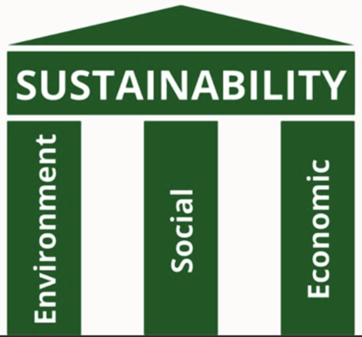
The Three Pillars of Sustainability
The three pillars of sustainability — environment, economy and society
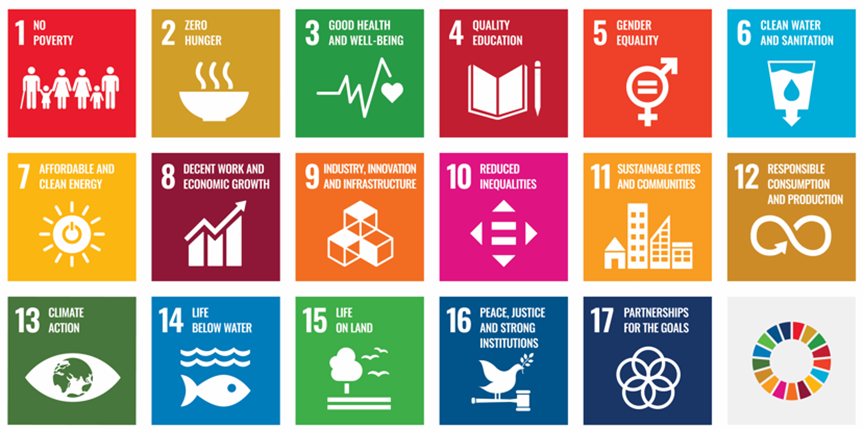
The 17 Sustainable Development Goals (SDGs)
In 2015, world leaders adopted the 17 SDGs as part of the UN's 2030 Agenda for Sustainable Development. These goals frame the global sustainability challenge — and they connect directly to everything we deliver at Bradford College.
Click image to explore all 17 goals on the UN website ↗
The 17 Sustainable Development Goals — what they are and why they matter
Activity: Your 3 SDGs
It's unlikely that you'll cover all 17 SDGs. But which 3 are most relevant to the content you deliver? Select them below.
Select 3 SDGs to continue.
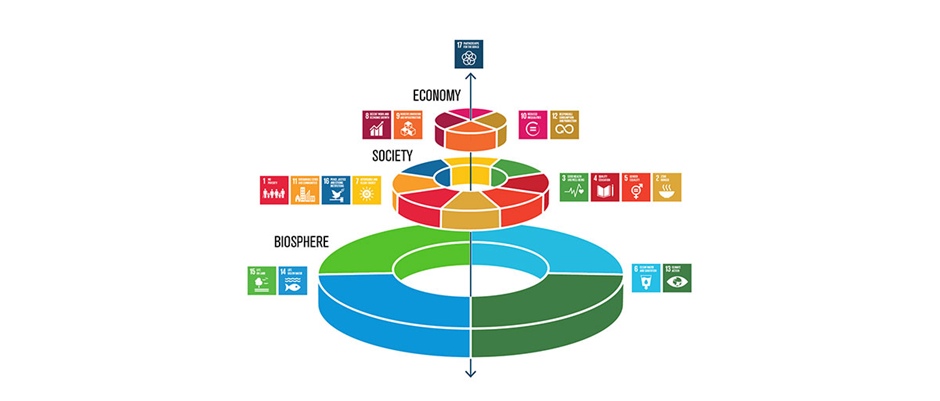
The Wedding Cake Model
The Wedding Cake model — why the biosphere is the foundation, not the economy
The wedding cake model (Stockholm Resilience Centre) shows that the environment is the foundation for everything else. Society depends on it. The economy depends on society.
Key insight
The economy exists within society, which exists within the biosphere. Not the other way around.
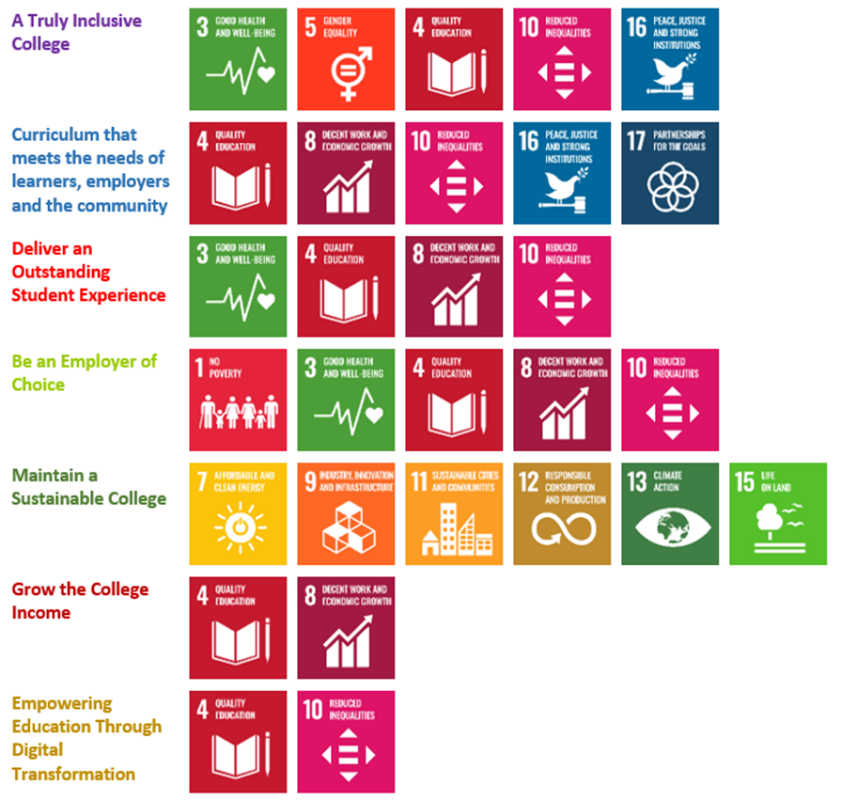
Bradford College's six strategic goals align directly with the UN SDGs:
Click the image to view it full-size
This means your ESD practice is not separate from college strategy — it directly supports it.
Reflection: Section 2
Having explored the three pillars, the SDGs and the wedding cake model — what feels most relevant to your subject area and why?
Responses are saved anonymously. Nothing is linked to your name.
Section 3
Core Principles of ESD
Transformative Pedagogy
ESD is an integral part of a quality education, and a lifelong learning process. It relates not only to what we learn, but also how we learn it. It's about creating conditions for genuine learning and change, rather than simply delivering information.
Core Principles of ESD — Part 1
Teaching about vs teaching for sustainability
Teaching about sustainability focuses on understanding climate science, sustainability issues or the 17 SDGs. This can build environmental literacy and factual understanding, but just knowing about these issues is not enough — education needs to actively cultivate the values and skills to address them.
Teaching for sustainability goes deeper — ESD is an action-oriented and transformative pedagogy where learners are encouraged to engage with sustainability issues to create a more sustainable future.
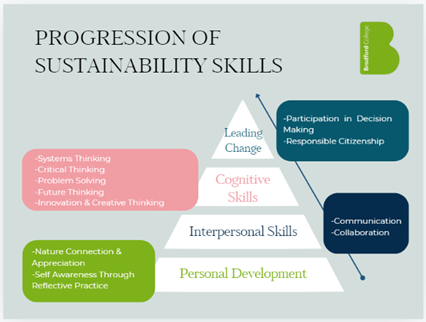
It is aimed at developing the values and competencies needed to drive positive change — including student agency, active citizenship and systemic thinking. (See the Skills Progression Model for more.)
Many of the best ESD activities aren't labelled as 'sustainability' — much of what makes ESD are examples of excellent teaching that are already valued in curriculum design at Bradford College: enquiry-based learning, real-world application, student voice, etc.
The benefits include: stronger critical thinking, more engaged learners, greater real-world relevance, and better preparation for the workplace.
Bradford's diverse learner community brings a richness of perspectives that is an asset in ESD — different backgrounds, cultures and lived experiences all have something to contribute to how we understand and address sustainability.
At the heart of ESD is a commitment to equity and inclusion — understanding that sustainability challenges are not experienced equally, and that true sustainability must centre those most affected.
This means ensuring learners see themselves in the curriculum and that teaching resources are diverse and inclusive. (Visit the Equity Hub ↗)
Bradford is one of the UK's youngest cities, with significant growth in sectors linked to the green economy and social care. ESD equips our learners for the Bradford they are going to shape.
"Green jobs will not be niche. We anticipate that sustainability and climate change will touch every career."
— Department for Education (DfE)
The DfE Green Jobs Taskforce estimates that achieving net zero will require significant reskilling across every industry.
A purposeful curriculum that prepares learners for life and work.
Implementation
Active, engaging pedagogies that go beyond transmission of knowledge.
Impact
Learners who can think critically, act responsibly, and apply knowledge to the real world.
ESD isn't the responsibility of one person or one department. The most effective ESD is embedded college-wide — in the curriculum, in estates, in student services, in leadership. This hub is part of that whole-institution approach.
You don't need to do this alone. The Sustainability Lead is here to support you — and the sustainability spotlights in this hub show that colleagues across the college are already doing remarkable things.
Reflection: Section 3
What questions do you have so far? These could be about ESD specifically, or about sustainability more broadly. What additional information or support would you find useful?
Responses are saved anonymously. Nothing is linked to your name.
Section 4
Activities & Planning
Activities and pedagogical approaches that can be adapted for any subject.
Active vs passive learning — ESD goes beyond cognitive learning and seeks to develop values and attitudes.
Leading change is the ultimate goal — learners are empowered to become active participants in their learning, rather than passive recipients.
ESD works best when learners are doing — not just hearing about sustainability.
Activity Bank
Ready-to-use activities to try with your learners. Each one is tagged with a subject, and shows where it could link to maths or English.
Choose an activity
Activity 1
Value Ranking
This activity encourages learners to assess how important sustainability is to them, and the choices they may make.
Choose four vocationally relevant options for learners to consider. For example, this could be types of insulation material for construction, menu options in catering, treatment options in health, or interventions in education.
Using real-life contexts, ask learners to rank the options by cost, time, customer need, etc. For example:
Which option would be the most cost effective?
Which option would you advise the customer to choose?
Which option would make the business the most money?
Sustainability (or elements of sustainability) should always be prioritised at least once during the activity, for example:
Which option would save the customer the most energy?
Which option would create the least waste?
The options can be ranked multiple times for different priorities. There will inevitably be clashes and compromises to be made, so encourage learners to reflect on how sustainability needs to be considered in decision making, and how their decisions impact sustainability outcomes.
SubjectConstruction
Potential maths links: comparing costs, measurements and energy savings between the insulation options.
Insulation Sort
An interactive version for Construction. Learners read about four insulation materials, then drag them into order for each scenario.
This activity is taken from the work of Geoff Petty, 2023.
Activity 2
Group Challenges, Problem-Based Learning and Debates
Learners engage with real life sustainability dilemmas connected to their vocational area.
Sustainability provides an endless supply of genuine problems that matter. Present learners with a sector challenge and ask them to work collaboratively to propose a solution.
Collaborative challenges could include an employer set project to redesign a product, or a community campaign that tackles a local challenge.
Debate — learners research then argue both sides before reaching their own position.
SubjectTravel and Tourism
Potential English links: speaking and listening (discussion and debate) and writing (a proposal or recommendation).
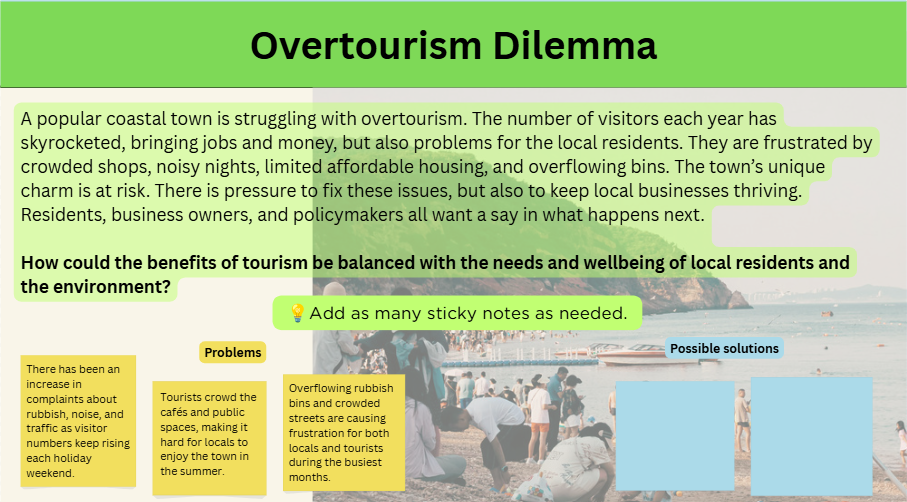
Example — sustainable tourism. A popular destination is dealing with the pressures of over-tourism. Problems include:
strain on local services
overcrowded public spaces and beaches
traffic congestion, noise pollution and anti-social behaviour
At the same time, tourism businesses are worried that restricting visitors could reduce income and jobs. Learners will need to consider responsible consumption, ethical tourism, and the environmental impacts of travel. Their solutions will need to balance:
the financial benefits of tourism
environmental protection
quality of life for residents
and visitor experience
Click the image to open it full size. No login needed, so you can print it or share it with learners.
Shared by a colleague
Subject
Share an activity
Tried something that works?
Send it to Chelsie Naylor, Sustainability Lead. She'll look at every one, and good fits are added to the Activity Bank for colleagues to use.
Approaches
Learners can be co-creators of ESD, not just recipients. Select a tab below to explore each approach.
Learners are not just recipients of ESD — they can also be co-creators. Involving learners in shaping their own learning experience builds genuine ownership and agency. The other tabs show approaches you can use to build that voice.
→Group Work — learners have different roles within the team
→Own strengths/weaknesses — reflect on what they have to offer
→Shared sense of responsibility
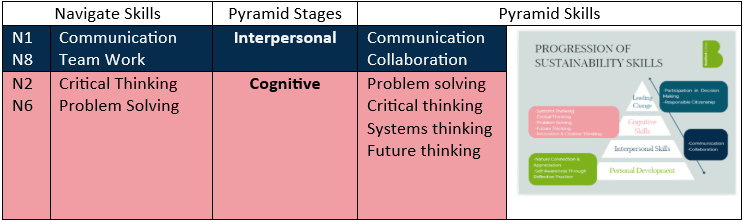
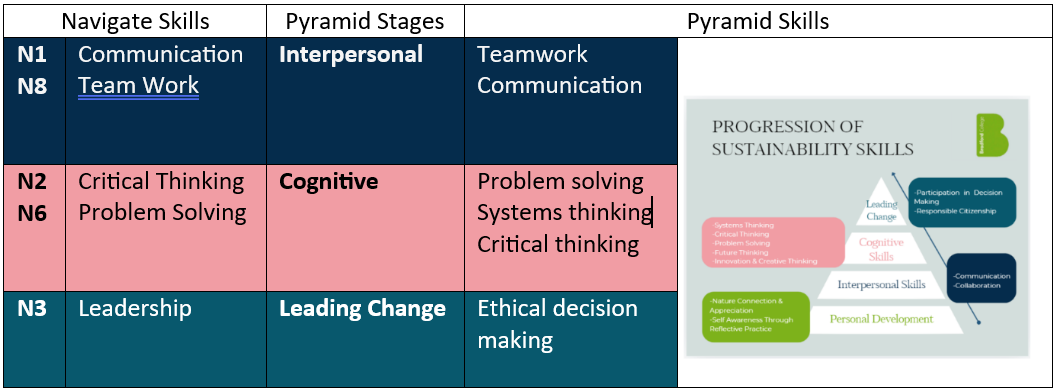
→Develop skills — across all areas of the sustainability skills progression pyramid
Some of the most powerful ESD is student-led — where learners design, lead and evaluate their own projects and sustainability initiatives.
For example, learners could decide which local issue to tackle via a community campaign.
Multi Modal Learning Pathways — learners have a choice of different ways to apply their learning:
→Written response
→Video
→Blog post
→Social media campaign
→Formal presentation
Reflection: Section 4
Which activities or approaches feel most suitable for your subject and teaching style? Choose one and adapt it for your curriculum area, then share it here for others in your department to use.
Responses are saved anonymously. Nothing is linked to your name.
Lesson Planning Tools
Intent: What sustainability knowledge, skills or values do I want my learners to develop?
Implementation: What activities, discussions or experiences will develop these?
Impact: How will I know learners have developed them? What does it look like?
Weave ESD into your planning, without starting from scratch.
You don't need to redesign your curriculum. Lesson Weaver can use your existing planning to include ESD principles and sustainability for you. Bring an existing plan and use it to incorporate ESD, the SDGs and sustainability skills.
It works by mapping SDGs, sustainability skills and ESD pedagogies onto what you already plan to teach.
Lesson Weaver — three questions
1
Which SDGs connect to this topic? Even if it's not obvious, most topics have at least one SDG connection — start there.
2
What sustainability skill can this develop? Critical thinking, systems thinking, empathy, collaboration, civic engagement, creative problem-solving.
3
Which active teaching strategy could you use? Draw on the activities and approaches from earlier in this section.
Develop a culture of enquiry. You're not expected to be an expert in sustainability. Facilitate discussions with your learners and learn together. That in itself is a form of transformative pedagogy.
Solutions-focused, not doom-focused
Tap to reveal ↻
Simply raising awareness of sustainability challenges can lead to disengagement or eco-anxiety. Solutions should be action-focused — empowering learners to contribute to positive change.
It's not an extra — weave it in
Tap to reveal ↻
Weave it in to enhance employability, responsible citizenship and make positive contributions to society.
Think broadly
Tap to reveal ↻
Include fairness, equity, social responsibility and community impact.
Connect it to vocational contexts
Tap to reveal ↻
Connect it to vocational contexts so learners see its relevance to them.
Develop awareness of social and global issues
Tap to reveal ↻
Give learners opportunities to develop an awareness of social and global issues, alongside knowledge, skills and values.
Avoid superficial activities and box-ticking
Tap to reveal ↻
Use real-world projects that are practical and meaningful.
How could this look in your curriculum area?
Business & EnterpriseSustainable business models, supply chain ethics, green marketing, social enterprise, SDG reporting frameworks. What does a successful business look like in a net-zero world?Engineering & ConstructionNet zero buildings, renewable energy systems, circular economy in manufacturing, green infrastructure. Every built environment decision has a sustainability dimension.Hair & BeautySustainable ingredients, cruelty-free products, reducing salon waste, ethical supply chains, inclusive client consultation. The beauty industry is transforming rapidly.Health & Social CareSocial determinants of health, environmental health equity, sustainable NHS, mental health and eco-anxiety. Sustainable lifestyles, community health and inclusive fitness.Computing & DigitalDigital carbon footprint, sustainable web design, data ethics, AI and environmental impact, green tech solutions. Digital transformation has real environmental costs — and opportunities.Catering & HospitalityFood miles, seasonal menus, food waste reduction, fair trade, sustainable tourism, plant-based nutrition. Food is one of the highest-impact sustainability areas — and it's your specialism.
Now take the self-assessment again to see how your confidence and practice has developed. Browse the Sustainability Spotlights to see colleagues across Bradford College who are already embedding ESD — and use the Resources Hub for tools to help you go further.
You've seen the subject prompts above — now share your own. How could you embed ESD in your curriculum area? Your idea and curriculum area are saved to help shape future ESD support and sustainability spotlights across the college.
Your idea is stored with your curriculum area so the Sustainability Lead can build on it. Please don't include your name.
The Reflection Wall shows anonymous responses from Bradford College staff as they work through the Learning Journey.
Your reflection will appear there too, once submitted — but it will never be linked to your name, email, or department. Nobody can identify who wrote what.
See how your colleagues are thinking about ESD across the college.